Showing posts with label tecate. Show all posts
History of the Cervecería de Mexicali
This company was founded in 1924 and has installed its factory and cellars in a large, attractive building made of wood faced with American cement, which gives it an appearance exactly like granite.
The latest advances in industrial chemistry and sterilzation have been incorporated into the manufacturing process of this beer, the raw materials of which are barley malt from the United States, hops from Bohemia, and rice from Mexico.
On the fourth floor of the brewery is a Columbia mill that crushes the rice and sends it to a blender. On the same floor is a machine that separates the chaff from the malted barley. The rice and barley grists are turned into a cauldron in which they are cooked briefly before being sent to another cauldron where they get a more thorough cooking; this mixture receives the hops, which are first cleaned by a Muller Improved machine. From the second cauldron the cooking is continued in a third, after which the liquid passes through a copper sieve in order to remove the suspended solids. Then the wort is pumped into a cooler also on the fourth [scil., third] floor. There the wort's temperature is lowered so that it can be sent to the fermentation tanks. The beer doesn't leave these tanks until it's been matured for four months.
Baja's Visitor Assistance Hotline
The state of Baja California comes up with some unusual ways to help its tourists. Toward the end of the twentieth century, it posted bilingual attorneys in the tourist areas to resolve visitors' problems free of charge. In this century it has made use of advances in telephony to give its visitors access to government officials around the clock.
SecTurE, the State Secretariat of Tourism, maintains a line within the three-digit Special Services network of the Mexican telephone system. By dialing 078 from anywhere in the state of Baja California, help in English is available day or night. Any phone will do - a public phone, a private phone, even a cell phone from another country (so long as the subscriber has automatic roaming).
Additionally, whenever the operators of the emergency system receive a call in English, they'll transfer it to 078. This works equally for those who call the U.S. emergency number (911) while in Baja California or the European emergency number (112) or the Mexican emergency number (066). All phones in Mexico allow free access to 066.
The hotline offers reasonable assistance to visitors who need help with such things as directions, language, or cultural differences.
Labels:
baja california,
ensenada,
freebie,
medical tourism,
mexicali,
rosarito,
tecate,
tijuana,
transportation
0 comments
0 comments
How to choose a dentist in Baja California
You might be disappointed. Our advice is going to be pretty much the same as that for choosing a dentist in Outer Mongolia. On the bright side, our dentists are more plentiful and better trained than what you might encounter in Outer Mongolia.
The first step in both places is to overcome the cultural discomfort of traveling for professional services beyond one’s neighborhood. “What if I pick a bad dentist?” is the greatest fear when you’re in a different town. Well, relax. Bad is very rare these days because of all the quality controls in place. The worst we’ve heard of so far has been an average dentist who charged like he was the best.
After that, we recommend you research your options thoughtfully, whittle your candidates down to a short list of four to six dentists, interview them, and make your decision based on who made the most sense to you.
“My dentist in Los Angeles thought he was a Mercedes mechanic” writes one of our correspondents. “I left him fifteen years ago and have been going to a dentist in Tijuana ever since. Now I’m not afraid to sit in the chair and, even better, my teeth stay fixed.”
Our correspondent is not alone. Because the dentistry in Mexico is of world-class quality while also being relatively inexpensive, you’ll find concentrations of dentists along the border from Tijuana all the way to Matamoros. The Asociación Dental Mexicana counts more than five thousand members in the central part of Tijuana alone.
The ADM didn’t count the many dentists who are not members. Nor does that number include the thousands of ADM members in Tijuana who practice outside of downtown and the Zona Río. It does not include any of the hundreds of ADM dentists in Ensenada, Rosarito or Los Algodones, nor the large numbers in Mexicali and Tecate. Dentistry along this border is very serious business and has been so for some while now.
Labels:
baja california,
dentistry,
ensenada,
medical tourism,
mexicali,
rosarito,
tecate,
tijuana
26 comments
26 comments
Baja’s Medical Ombudsmen
• • • SEE UPDATED INFORMATION AT END OF ARTICLE • • •

Every culture has its own expectations concerning their medical profession. The ancient Chinese paid their physician every day they were healthy in order to be treated for free whenever they were ill. In Mexico, doctors tend to be extremely Hippocratic in their approach – the idea here is that people whose social position has allowed them to learn a great deal now want to help you feel better. But what happens when a patient doesn’t see the improvement he expected?
In the United States, an unhappy patient pays a lot of money to a malpractice attorney and hopes for the best. In Mexico, that sort of patient has more options: he or she can go to the Ministerio Público (the district attorney) to file a criminal complaint for malpractice, go to PROFECO (the federal attorney for the protection of consumers) to file a civil complaint, or ask a medical commission to resolve the problem with expert arbitration. There is no cost involved in any of these options. Additionally, one can hire a private attorney to file the case in civil court, similar to what is done in the U.S. More and more, the medical commissions are becoming the preferred route.
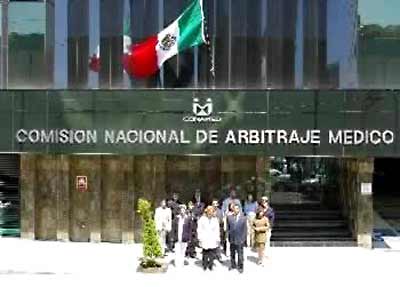
CAME-BC, the Comisión de Arbitraje Médico del Estado de Baja California, is part of the state government and has been around in one form or another for about a decade. Originally it maintained a single office in Mexicali, the state capital. “To do our job, we have to be where the patients are,” says Dr Agustín Escobar, the head of the commission, “so we came to Tijuana in 2008. That’s where most of the medicine is being practiced in this state. Very soon we will be opening offices in Rosarito, Ensenada, and Tecate. We’re also working on a web presence like the one our big brother in Mexico City has.”
Every culture has its own expectations concerning their medical profession. The ancient Chinese paid their physician every day they were healthy in order to be treated for free whenever they were ill. In Mexico, doctors tend to be extremely Hippocratic in their approach – the idea here is that people whose social position has allowed them to learn a great deal now want to help you feel better. But what happens when a patient doesn’t see the improvement he expected?
In the United States, an unhappy patient pays a lot of money to a malpractice attorney and hopes for the best. In Mexico, that sort of patient has more options: he or she can go to the Ministerio Público (the district attorney) to file a criminal complaint for malpractice, go to PROFECO (the federal attorney for the protection of consumers) to file a civil complaint, or ask a medical commission to resolve the problem with expert arbitration. There is no cost involved in any of these options. Additionally, one can hire a private attorney to file the case in civil court, similar to what is done in the U.S. More and more, the medical commissions are becoming the preferred route.
CAME-BC, the Comisión de Arbitraje Médico del Estado de Baja California, is part of the state government and has been around in one form or another for about a decade. Originally it maintained a single office in Mexicali, the state capital. “To do our job, we have to be where the patients are,” says Dr Agustín Escobar, the head of the commission, “so we came to Tijuana in 2008. That’s where most of the medicine is being practiced in this state. Very soon we will be opening offices in Rosarito, Ensenada, and Tecate. We’re also working on a web presence like the one our big brother in Mexico City has.”
Labels:
baja california,
culture,
ensenada,
medical tourism,
mexicali,
rosarito,
tecate,
tijuana
0 comments
0 comments
Do I need a passport to visit Baja California?
• • • SEE UPDATED INFORMATION AT END OF ARTICLE • • • 
The simple answer for all visitors from the U.S. and for most visitors from Canada is No, you don’t need no pinche passport. Here at the border, we see people crossing all the time without one. Across the border, at Across the Border, Anna Cearley has been collecting up reports from readers whose experiences confirm what we say.
And yet people continue to ask and the Internet’s self-appointed experts continue to give the same mistaken answer. The confusion has been caused from what both governments have been telling us. The U.S. government puts up frightening-sounding websites like “GetYouHome.gov” to talk about their “requirement” for “WHTI-compliant documents” and the Mexican government talks about enhancing security in order to continue the disastrous war on drugs. Nonetheless, people keep crossing into California and Baja California just as they have always been doing.
Those of us in The Real Tijuana cross the border, collectively, pretty much every day. We are Mexican citizens, U.S. citizens, and dual citizens. Our documentation varies but only the Mexican nationals among us use WHTI-compliant identification (laser visas and green cards) – the rest of us cross with expired U.S. passports, one of which is more than thirty years old. We have never been sent to Secondary for not being WHTI-compliant. We often see other people crossing with just a birth certificate.
Since the same questions have been cropping up over and over again, we thought it might be helpful to present a FAQ on the subject as it applies to our beat, the border between California and Baja California.
We do not intend to discourage the use of passports – we agree with the Mexican government that the passport is the “ideal international identity document” – but we disagree with irrational impediments to tourism and we are categorically opposed to any restriction on fronterizo culture. Since it is to the government’s benefit that its citizens carry passports, it behooves our governments to facilitate our access to this document. And yet both the Mexican and the U.S. governments place escalating burdens on the individual citizen instead.
The simple answer for all visitors from the U.S. and for most visitors from Canada is No, you don’t need no pinche passport. Here at the border, we see people crossing all the time without one. Across the border, at Across the Border, Anna Cearley has been collecting up reports from readers whose experiences confirm what we say.
And yet people continue to ask and the Internet’s self-appointed experts continue to give the same mistaken answer. The confusion has been caused from what both governments have been telling us. The U.S. government puts up frightening-sounding websites like “GetYouHome.gov” to talk about their “requirement” for “WHTI-compliant documents” and the Mexican government talks about enhancing security in order to continue the disastrous war on drugs. Nonetheless, people keep crossing into California and Baja California just as they have always been doing.
Those of us in The Real Tijuana cross the border, collectively, pretty much every day. We are Mexican citizens, U.S. citizens, and dual citizens. Our documentation varies but only the Mexican nationals among us use WHTI-compliant identification (laser visas and green cards) – the rest of us cross with expired U.S. passports, one of which is more than thirty years old. We have never been sent to Secondary for not being WHTI-compliant. We often see other people crossing with just a birth certificate.
Since the same questions have been cropping up over and over again, we thought it might be helpful to present a FAQ on the subject as it applies to our beat, the border between California and Baja California.
We do not intend to discourage the use of passports – we agree with the Mexican government that the passport is the “ideal international identity document” – but we disagree with irrational impediments to tourism and we are categorically opposed to any restriction on fronterizo culture. Since it is to the government’s benefit that its citizens carry passports, it behooves our governments to facilitate our access to this document. And yet both the Mexican and the U.S. governments place escalating burdens on the individual citizen instead.
A new way to get border-wait information
• • • SEE UPDATED INFORMATION AT END OF ARTICLE • • •

Perhaps the most annoying aspect of crossing the U.S.–Mexican border is the unpredictabiity of the Customs lines. Sometimes five minutes, sometimes five hours, sometimes caused foreseeably, sometimes capriciously. To anticipate this difficulty, every “frequent crosser” has their favorite source of border-wait information.
Decades ago, the local radio stations began sending spotters to the San Ysidro border to phone in their Reporte de la Garita every half-hour. Channel 12 and Síntesis television now issue reports on the hour and half-hour during their news programs. When the webcam craze hit, Telnor (the local telephone company) began offering real-time images of the four major sources of vehicular traffic at the point where they converge, later adding a fifth webcam for Otay’s non-commercial lanes. Recorded information is available by telephone (San Ysidro Port of Entry, +1-619-690-8999; Otay Mesa, +1-619-671-8999; Telnor’s service, +52-664-700-7000; from Mexican cell phones, *LINEA). Most popular recently are various Internet portals, primarily tourist sites and Tijuana newspapers, that embed the U.S. government’s reports and the Telnor webcam feeds.

A programmer here in Tijuana known by the nom de guerre “IsReal” has come up with yet another way to get border-wait information: it can now be integrated into your web-browser.
GaritasBC is an extension for Firefox that sits unobtrusively in the right-hand corner of your status bar. When you roll your cursor over it, a tooltip window pops up containing the most current reports for Tijuana and Tecate; right-click to select from a menu of Telnor webcams. The current version of the extension also allows you to access the same information for the Mexicali crossing.

GaritasBC currently reports all northbound wait times, in Spanish. The source of this information is U.S. Customs and Border Protection, which currently updates its data at the top of every hour. The GaritasBC extension checks for new data every ten minutes, however, so its reports are as timely as the CBP affords.
The extension can be installed automatically by downloading it while running Firefox.
Once installed, the name “GaritasBC” will appear in the status bar at the bottom-right corner of your monitor. Place your cursor over the name and the current report will appear at the tip of your cursor. Right-click (or control-click) on the name and a pop-up menu will offer the available webcams; selecting one will replace whatever is in the active window of your browser with the current static image from that webcam.
To switch between Tijuana/Tecate and Mexicali reports, chose the appropriate radio button in the extension’s preference: from the Firefox menubar -> Tools -> Add-ons -> Extensions -> GaritasBC -> Preferences.
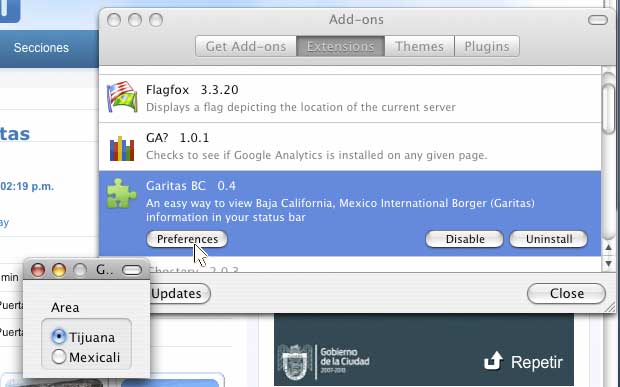
IsReal describes the development of GaritasBC as a labor of love – in other words, it is not being promoted commercially. Consequently, Firefox continues to classify it as beta software (primarily because of its austere interface and because it’s still waiting to be reviewed by the Firefox editorial team) even though it is now in its fifth version and has received no reports of bugs or instability. If the extension generates enough interest, IsReal has plans to get it out of beta by giving it more a of a graphical interface and by including reports for all the U.S. terrestrial ports of entry along the Mexican border.
Updated August 2018
The world now uses mobile apps, so this Firefox add-on has not been updated and is not compatible with current versions of the browser.
There are now about two dozen of such smartphone apps to choose from … and all of them show a lot of user dissatisfaction due to inaccurate wait times.
We need to be clear at this point: GaritasBC – as well as the smartphone apps that have replaced it – all suffer from a significant defect in that they’re little more than different “skins” for displaying Customs and Border Protection’s RSS feed.
Official CBP procedure has each Port of Entry along both land borders sending to Washington DC before the top of each hour what it estimates its wait-times are. Washington then makes the basic information available to the general public on its Border Wait Times webpage. These wait times are concerned with travelers coming into the US only. We know of no reports available for the traffic entering Tijuana.
When you check users’ reviews of the currently available apps, you’ll see a lot of anger over the inaccurate times but not over the apps themselves. As far as Tijuana goes, at least, the CBP has been wildly dishonest in its reporting of these numbers. Some of the inaccuracy is inherent in the CBP’s methodology: the data are sent to Washington only once every hour and, if that transmission arrives late, those data won’t be reported by CBP until the top of the following hour. Whenver the hamsters turning the treadmill that powers the CBP system get tired, the website continues to report the last transmission it received until the hamsters start working again.
Another reason for the inaccuracy – at least according to local lore going back several generations – is due to tortuguismo, that is, a tacit governmental policy of impeding travelers so as to make the idea of avoiding Tijuana and staying in the US more attractive. Motorists often comment that it takes them just as long to clear Customs regardless of whether there are three cars or thirty cars in front of them. Pedestrians have even stranger stories to tell.
To counter the unreliability of the official information, there have already been several attempts to harvest real-time data. One pioneering effort in this direction, bordertraffic.com, has been trying to monetize the existing CCTV traffic feeds: this might make sense for those who cross the border frequently and who are willing to learn how to interpret the video information. UCSD’s experimental app, “Border Wait Times”, attempted to crowdsource the wait times by means of its users’ GPS pings – excellent methodology – but its web server, traffic.calit2.net, was taken offline by the university without explanation. Other attempts at crowdsourced data, such as Garita Center, still need to attract a crowd.
Crossing the border on 4 July 1920
Perhaps the most annoying aspect of crossing the U.S.–Mexican border is the unpredictabiity of the Customs lines. Sometimes five minutes, sometimes five hours, sometimes caused foreseeably, sometimes capriciously. To anticipate this difficulty, every “frequent crosser” has their favorite source of border-wait information.
Decades ago, the local radio stations began sending spotters to the San Ysidro border to phone in their Reporte de la Garita every half-hour. Channel 12 and Síntesis television now issue reports on the hour and half-hour during their news programs. When the webcam craze hit, Telnor (the local telephone company) began offering real-time images of the four major sources of vehicular traffic at the point where they converge, later adding a fifth webcam for Otay’s non-commercial lanes. Recorded information is available by telephone (San Ysidro Port of Entry, +1-619-690-8999; Otay Mesa, +1-619-671-8999; Telnor’s service, +52-664-700-7000; from Mexican cell phones, *LINEA). Most popular recently are various Internet portals, primarily tourist sites and Tijuana newspapers, that embed the U.S. government’s reports and the Telnor webcam feeds.
A programmer here in Tijuana known by the nom de guerre “IsReal” has come up with yet another way to get border-wait information: it can now be integrated into your web-browser.
GaritasBC is an extension for Firefox that sits unobtrusively in the right-hand corner of your status bar. When you roll your cursor over it, a tooltip window pops up containing the most current reports for Tijuana and Tecate; right-click to select from a menu of Telnor webcams. The current version of the extension also allows you to access the same information for the Mexicali crossing.
click to enlarge
GaritasBC currently reports all northbound wait times, in Spanish. The source of this information is U.S. Customs and Border Protection, which currently updates its data at the top of every hour. The GaritasBC extension checks for new data every ten minutes, however, so its reports are as timely as the CBP affords.
The extension can be installed automatically by downloading it while running Firefox.
Once installed, the name “GaritasBC” will appear in the status bar at the bottom-right corner of your monitor. Place your cursor over the name and the current report will appear at the tip of your cursor. Right-click (or control-click) on the name and a pop-up menu will offer the available webcams; selecting one will replace whatever is in the active window of your browser with the current static image from that webcam.
To switch between Tijuana/Tecate and Mexicali reports, chose the appropriate radio button in the extension’s preference: from the Firefox menubar -> Tools -> Add-ons -> Extensions -> GaritasBC -> Preferences.
click to enlarge
IsReal describes the development of GaritasBC as a labor of love – in other words, it is not being promoted commercially. Consequently, Firefox continues to classify it as beta software (primarily because of its austere interface and because it’s still waiting to be reviewed by the Firefox editorial team) even though it is now in its fifth version and has received no reports of bugs or instability. If the extension generates enough interest, IsReal has plans to get it out of beta by giving it more a of a graphical interface and by including reports for all the U.S. terrestrial ports of entry along the Mexican border.
Updated August 2018
The world now uses mobile apps, so this Firefox add-on has not been updated and is not compatible with current versions of the browser.
There are now about two dozen of such smartphone apps to choose from … and all of them show a lot of user dissatisfaction due to inaccurate wait times.
We need to be clear at this point: GaritasBC – as well as the smartphone apps that have replaced it – all suffer from a significant defect in that they’re little more than different “skins” for displaying Customs and Border Protection’s RSS feed.
Official CBP procedure has each Port of Entry along both land borders sending to Washington DC before the top of each hour what it estimates its wait-times are. Washington then makes the basic information available to the general public on its Border Wait Times webpage. These wait times are concerned with travelers coming into the US only. We know of no reports available for the traffic entering Tijuana.
When you check users’ reviews of the currently available apps, you’ll see a lot of anger over the inaccurate times but not over the apps themselves. As far as Tijuana goes, at least, the CBP has been wildly dishonest in its reporting of these numbers. Some of the inaccuracy is inherent in the CBP’s methodology: the data are sent to Washington only once every hour and, if that transmission arrives late, those data won’t be reported by CBP until the top of the following hour. Whenver the hamsters turning the treadmill that powers the CBP system get tired, the website continues to report the last transmission it received until the hamsters start working again.
Another reason for the inaccuracy – at least according to local lore going back several generations – is due to tortuguismo, that is, a tacit governmental policy of impeding travelers so as to make the idea of avoiding Tijuana and staying in the US more attractive. Motorists often comment that it takes them just as long to clear Customs regardless of whether there are three cars or thirty cars in front of them. Pedestrians have even stranger stories to tell.
To counter the unreliability of the official information, there have already been several attempts to harvest real-time data. One pioneering effort in this direction, bordertraffic.com, has been trying to monetize the existing CCTV traffic feeds: this might make sense for those who cross the border frequently and who are willing to learn how to interpret the video information. UCSD’s experimental app, “Border Wait Times”, attempted to crowdsource the wait times by means of its users’ GPS pings – excellent methodology – but its web server, traffic.calit2.net, was taken offline by the university without explanation. Other attempts at crowdsourced data, such as Garita Center, still need to attract a crowd.
Subscribe to:
Posts (Atom)