Showing posts with label transportation. Show all posts

Baja's Visitor Assistance Hotline

~ ~

The state of Baja California comes up with some unusual ways to help its tourists. Toward the end of the twentieth century, it posted bilingual attorneys in the tourist areas to resolve visitors' problems free of charge. In this century it has made use of advances in telephony to give its visitors access to government officials around the clock.

SecTurE, the State Secretariat of Tourism, maintains a line within the three-digit Special Services network of the Mexican telephone system. By dialing 078 from anywhere in the state of Baja California, help in English is available day or night. Any phone will do - a public phone, a private phone, even a cell phone from another country (so long as the subscriber has automatic roaming).

Additionally, whenever the operators of the emergency system receive a call in English, they'll transfer it to 078. This works equally for those who call the U.S. emergency number (911) while in Baja California or the European emergency number (112) or the Mexican emergency number (066). All phones in Mexico allow free access to 066.

The hotline offers reasonable assistance to visitors who need help with such things as directions, language, or cultural differences.

Mike, the unwily coyote

~ ~
inmigracion.jpg

Mike is one of Tijuana’s newer immigrants from the United States. He moved here during the twenty-first century. He recently found himself involved in what the law broadly refers to “human trafficking”. In our local slang, he was a coyote. Or, as he says, “I helped people get into the U.S. without all the red tape.”

Mike had been a salesman in southern California who was “transitioned” into a commission-only job. He came to Tijuana because he couldn’t afford the place where he used to live. He wound up near the Otay crossing because, as he says, “the rents are low and we’re real close to the border”. Unfortunately for Mike, sales jobs were still far away.

“I tried a lot of jobs. Another gringo in the Zona Norte hooked me up with a telemarketing gig, a boilerroom in Mira Mesa, but I couldn’t meet their sales quotas. I walked the streets of Bonita for a remodeling contractor, telling people they had mold in their homes in order to get them to sign up. I started a website but it isn’t making any money. I went to Telvista because they said I only need to speak English, but that wasn’t true – I also need to permission to work in Mexico!” Mike hasn’t bothered to do any immigration paperwork.

“One day I was walking down Calle Coahuila and a chicano from Sylmar came up to me asking if I wanted a job. All I had to do was drive somebody else’s car across the border and they’d pay me a thousand dollars. ‘What’s the catch?’ I asked. The guy said it wasn’t anything illegal or dangerous but Juan would be the one to explain.”

Do I need a passport to visit Baja California?

~ ~
• • • SEE UPDATED INFORMATION AT END OF ARTICLE • • •  pasaportes.jpg

The simple answer for all visitors from the U.S. and for most visitors from Canada is No, you don’t need no pinche passport. Here at the border, we see people crossing all the time without one. Across the border, at Across the Border, Anna Cearley has been collecting up reports from readers whose experiences confirm what we say.

And yet people continue to ask and the Internet’s self-appointed experts continue to give the same mistaken answer. The confusion has been caused from what both governments have been telling us. The U.S. government puts up frightening-sounding websites like “GetYouHome.gov” to talk about their “requirement” for “WHTI-compliant documents” and the Mexican government talks about enhancing security in order to continue the disastrous war on drugs. Nonetheless, people keep crossing into California and Baja California just as they have always been doing.

Those of us in The Real Tijuana cross the border, collectively, pretty much every day. We are Mexican citizens, U.S. citizens, and dual citizens. Our documentation varies but only the Mexican nationals among us use WHTI-compliant identification (laser visas and green cards) – the rest of us cross with expired U.S. passports, one of which is more than thirty years old. We have never been sent to Secondary for not being WHTI-compliant. We often see other people crossing with just a birth certificate.

Since the same questions have been cropping up over and over again, we thought it might be helpful to present a FAQ on the subject as it applies to our beat, the border between California and Baja California.

We do not intend to discourage the use of passports – we agree with the Mexican government that the passport is the “ideal international identity document” – but we disagree with irrational impediments to tourism and we are categorically opposed to any restriction on fronterizo culture. Since it is to the government’s benefit that its citizens carry passports, it behooves our governments to facilitate our access to this document. And yet both the Mexican and the U.S. governments place escalating burdens on the individual citizen instead.

A new way to get border-wait information

~ ~
• • • SEE UPDATED INFORMATION AT END OF ARTICLE • • •
border_crossing.jpg
Crossing the border on 4 July 1920

Perhaps the most annoying aspect of crossing the U.S.–Mexican border is the unpredictabiity of the Customs lines. Sometimes five minutes, sometimes five hours, sometimes caused foreseeably, sometimes capriciously. To anticipate this difficulty, every “frequent crosser” has their favorite source of border-wait information.

Decades ago, the local radio stations began sending spotters to the San Ysidro border to phone in their Reporte de la Garita every half-hour. Channel 12 and Síntesis television now issue reports on the hour and half-hour during their news programs. When the webcam craze hit, Telnor (the local telephone company) began offering real-time images of the four major sources of vehicular traffic at the point where they converge, later adding a fifth webcam for Otay’s non-commercial lanes. Recorded information is available by telephone (San Ysidro Port of Entry, +1-619-690-8999; Otay Mesa, +1-619-671-8999; Telnor’s service, +52-664-700-7000; from Mexican cell phones, *LINEA). Most popular recently are various Internet portals, primarily tourist sites and Tijuana newspapers, that embed the U.S. government’s reports and the Telnor webcam feeds.
telnor_cams.jpg


A programmer here in Tijuana known by the nom de guerre “IsReal” has come up with yet another way to get border-wait information: it can now be integrated into your web-browser.

GaritasBC is an extension for Firefox that sits unobtrusively in the right-hand corner of your status bar. When you roll your cursor over it, a tooltip window pops up containing the most current reports for Tijuana and Tecate; right-click to select from a menu of Telnor webcams. The current version of the extension also allows you to access the same information for the Mexicali crossing.

ext_in_use.jpg
click to enlarge

GaritasBC currently reports all northbound wait times, in Spanish. The source of this information is U.S. Customs and Border Protection, which currently updates its data at the top of every hour. The GaritasBC extension checks for new data every ten minutes, however, so its reports are as timely as the CBP affords.

The extension can be installed automatically by downloading it while running Firefox.

Once installed, the name “GaritasBC” will appear in the status bar at the bottom-right corner of your monitor. Place your cursor over the name and the current report will appear at the tip of your cursor. Right-click (or control-click) on the name and a pop-up menu will offer the available webcams; selecting one will replace whatever is in the active window of your browser with the current static image from that webcam.

To switch between Tijuana/Tecate and Mexicali reports, chose the appropriate radio button in the extension’s preference: from the Firefox menubar -> Tools -> Add-ons -> Extensions -> GaritasBC -> Preferences.
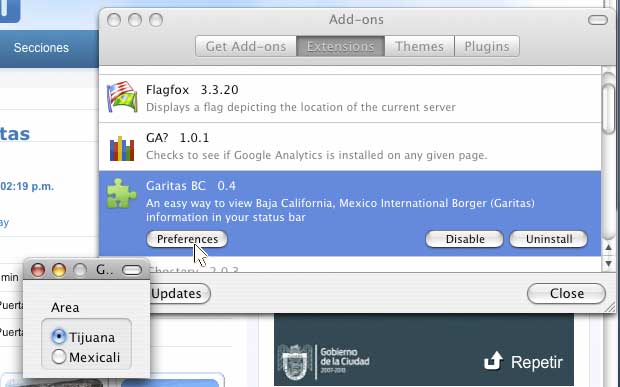
garitas_prefs.jpg
click to enlarge

IsReal describes the development of GaritasBC as a labor of love – in other words, it is not being promoted commercially. Consequently, Firefox continues to classify it as beta software (primarily because of its austere interface and because it’s still waiting to be reviewed by the Firefox editorial team) even though it is now in its fifth version and has received no reports of bugs or instability. If the extension generates enough interest, IsReal has plans to get it out of beta by giving it more a of a graphical interface and by including reports for all the U.S. terrestrial ports of entry along the Mexican border.

Updated August 2018

The world now uses mobile apps, so this Firefox add-on has not been updated and is not compatible with current versions of the browser.

There are now about two dozen of such smartphone apps to choose from … and all of them show a lot of user dissatisfaction due to inaccurate wait times.

We need to be clear at this point: GaritasBC – as well as the smartphone apps that have replaced it – all suffer from a significant defect in that they’re little more than different “skins” for displaying Customs and Border Protection’s RSS feed.

Official CBP procedure has each Port of Entry along both land borders sending to Washington DC before the top of each hour what it estimates its wait-times are. Washington then makes the basic information available to the general public on its Border Wait Times webpage. These wait times are concerned with travelers coming into the US only. We know of no reports available for the traffic entering Tijuana.

When you check users’ reviews of the currently available apps, you’ll see a lot of anger over the inaccurate times but not over the apps themselves. As far as Tijuana goes, at least, the CBP has been wildly dishonest in its reporting of these numbers. Some of the inaccuracy is inherent in the CBP’s methodology: the data are sent to Washington only once every hour and, if that transmission arrives late, those data won’t be reported by CBP until the top of the following hour. Whenver the hamsters turning the treadmill that powers the CBP system get tired, the website continues to report the last transmission it received until the hamsters start working again.

Another reason for the inaccuracy – at least according to local lore going back several generations – is due to tortuguismo, that is, a tacit governmental policy of impeding travelers so as to make the idea of avoiding Tijuana and staying in the US more attractive. Motorists often comment that it takes them just as long to clear Customs regardless of whether there are three cars or thirty cars in front of them. Pedestrians have even stranger stories to tell.

To counter the unreliability of the official information, there have already been several attempts to harvest real-time data. One pioneering effort in this direction, bordertraffic.com, has been trying to monetize the existing CCTV traffic feeds: this might make sense for those who cross the border frequently and who are willing to learn how to interpret the video information. UCSD’s experimental app, “Border Wait Times”, attempted to crowdsource the wait times by means of its users’ GPS pings – excellent methodology – but its web server, traffic.calit2.net, was taken offline by the university without explanation. Other attempts at crowdsourced data, such as Garita Center, still need to attract a crowd. 

Tijuana without your car, part 1 of 2

~ ~
• • • SEE UPDATED INFORMATION AT END OF PART 2 • • •

 Getting to and from the border

People who have moved to Tijuana from southern California all mention the same thing, that their friends don’t visit out of fear of driving across the border. Well, you don’t have to take your car across the border. You can have a much better time if you do but that’s really a question of your own comfort level. Most visitors, it seems, would rather leave their cars somewhere north of the border and proceed on foot. Fortunately, that’s an easy thing to do.

You don’t even need a car if you live close to the railroad. The train can take you all the way from Seattle to San Ysidro. Heavy rail (the Sunset Limited and the Coaster) will leave you at Union Station in downtown San Diego. Light rail (the trolley) continues on to the border. The trolley will take you from Union Station to the San Ysidro terminus in just under an hour. The Tijuana trolley is called the Blue Line even though every trolley in San Diego is painted red. There are also the Orange, Green, and Special Event lines, which go to other parts of the county, all painted red. Look for destination signs that read “San Ysidro / Tijuana” to be sure.

Wikipedia’s article on the trolley is found here. The official site is here. Both can supply you with more information.

Free parking is available at the last four trolley stations before the border as well as in Old Town. The trolley comes by every quarter-hour (during peak times, every eight minutes or so) and costs $2.50 per person one way. Vending machines at each station dispense tickets in exchange for U.S. quarters, dollar bills, and five-dollar bills. Passengers are spot-checked by the MTS police: those without a valid ticket are assessed a fine in excess of a hundred dollars.

The Blue Line is the trolley’s Cinderella – it brings in more than half of the money collected by the entire MTS and yet it is forever late and overcrowded. If you find your first trolley to be so full that its passengers are preventing its doors from closing, wait for the next trolley. Overcrowding is often caused by tardiness, meaning that the next trolley will likely show up quickly and be relatively empty.

MTS bus lines 929 (departing from Broadway and Front) and 932 (departing from the Eighth Street trolley station) also end at the international border. These busses stop at the end of Camiones Road, mere steps away from the entrance to Mexico. Both bus lines also stop at the Iris Avenue trolley station, where people who don’t want to walk over the causeway can transfer from the trolley to the bus. Be forewarned that these busses are often more overcrowded than the trolley.

You can also drive directly to the border and park there. To do so, get off the I-5 at the last exit before Mexico, Camino de la Plaza, and look for signs dealing with private parking areas. Rates vary both for price and duration – the lot behind Jack-in-the-Box, for example, charges on an eight-hour day. A much better option is the Border Station lot immediately to your right as you exit the freeway, which not only charges on a normal twenty-four-hour day but is also the U.S. terminus for the Mexicoach shuttle.

Everyone walking into Mexico passes through Mexican Customs. The Customs officer is supposed to inspect the baggage of every tenth person, as determined by the red and green lights controlled by what looks like a crosswalk button, but nowadays everyone puts their baggage on a conveyor belt to be x-rayed like Homeland Security does.

Tourists usually fly under this guy’s radar. If you make eye contact with the Customs official, just smile and keep walking. If he gestures to you, you’d better stop to see what he wants. If you need a translator, someone nearby is sure to be bilingual. But there’s really no reason to be afraid of the Mexican Customs official unless you’re carrying something extremely illegal.

You do not have to cross the border on foot. You can use a shuttle bus. Mexicoach TJ Passport leaves from the Border Station parking lot every hour on the hour from 6:00 a.m. to 6:00 p.m., passing to collect more passengers from the San Ysidro International Border trolley station and then heading into downtown Tijuana. Currently tickets cost four dollars one way or six dollars round trip.

You can follow this link to Tijuana without your car, part 2, which deals with getting around once you’ve crossed the border.

You can follow this link for a map of the landmarks mentioned in the two parts of this article.

Serious mass transit comes to Tijuana

~ ~
 • • • SEE UPDATED INFORMATION AT END OF ARTICLE • • • 

Many visitors have commented favorably about Tijuana’s public-transportation system because our busses are plentiful and cheap. Our current system’s greatest drawback, on the other hand, is that the routes serve individual colonias rather than the city as a whole. Traveling some distance within Tijuana can now be expensive and time-consuming and, as the city continues to expand, this one drawback will soon outweigh the existing system’s advantages.

The city of Tijuana has just opened bidding worldwide for the construction on the first trunk route of our new Sistema Metropolitano de Transporte Masivo. The plans are indeed metropolitan and massive, covering most of Tijuana’s twelve hundred square kilometers and comprising seven transit stations, eight trunk routes, ninety feeder routes, three local routes, nine suburban routes, and two auxiliary routes. According to the City Administrator’s office, this is a holistic approach to Tijuana’s public-transportation needs designed to increase efficiency, to lower costs, to reduce pollution, and to dovetail with the binational changes in store for the primary border crossing.