The tuna universitaria has come to Baja California

~ ~
Tuna UABC at Giuseppis

If you’re in the right restaurant at the right time, something unusual will happen. A bunch of guys show up dressed in Renaissance clothes, carrying Renaissance instruments. They begin playing in bright tones and quick rhythms – possibly Italian, to gringo ears, but the lyrics are unmistakably Spanish – while the little guy with the tambourine capers theatrically.

What happened to the mariachis and “La Bamba”? Has Tijuana suddenly become addicted to Lope de Vega? Or maybe the restaurant thought we’d like to watch “The Two Gentlemen of Verona” in translation?

It’s a bit disorienting, here in the city that began as a Hollywood-style fantasy, to encounter something so deeply traditional and so authentically hispanic as Baja’s first tuna universitaria. Even the name is confusing … the locals know tuna to be cactus fruit and the gringos think it’s a fish … but the term refers to a group of tunos, university students who sing for their supper.

The tradition can be traced back continuously to the beginning of the thirteenth century with the founding of the Studium Generale (now University) of Palencia during the reign of Alfonso VIII. Nowadays tunas are established throughout the Spanish-speaking world. They’re even found in such unlikely places as Oxford, Belgium, and Japan. In central Mexico, tunas date back to the Porfiriato. For UABC (the Universidad Autónoma de Baja California), however, the tuna arrived in 2008.

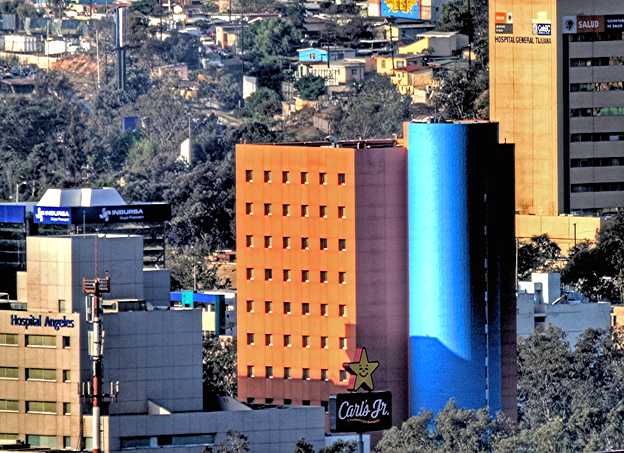
Tijuana’s health industry prepares for international competition

~ ~
hospitales_tij.jpg

by Laura Durán

Tijuana Health without Borders, the medical tourism business cluster that was created two years ago, now counts one hundred eighty organizations as members and has created the first academic program for medical tourism in all of Latin America.

Today more than ever Tijuana is looking to develop its tourism. Not necessarily the leisure tourism of earlier years, because that has been depressed by fear, Customs lines, and the recession. Instead, Tijuana’s new tourism is being fueled by medical necessity. Patients come here for the high quality of our medicine, because our doctors spend time with their patients, and because health care in Tijuana is much more affordable than it is in the United States.

“The response to our educational program exceeded anything we imagined” said Jorge Gutiérrez, the treasurer and logistics coordinator of the Cluster. “It demonstrates the degree of interest that exists in this area. We thought maybe twenty people would show up and instead we have one hundred thirty who are committing one hundred sixty hours of their time, an entire semester, to earn this university certificate.”

A new way to get border-wait information

~ ~
• • • SEE UPDATED INFORMATION AT END OF ARTICLE • • •
border_crossing.jpg
Crossing the border on 4 July 1920

Perhaps the most annoying aspect of crossing the U.S.–Mexican border is the unpredictabiity of the Customs lines. Sometimes five minutes, sometimes five hours, sometimes caused foreseeably, sometimes capriciously. To anticipate this difficulty, every “frequent crosser” has their favorite source of border-wait information.

Decades ago, the local radio stations began sending spotters to the San Ysidro border to phone in their Reporte de la Garita every half-hour. Channel 12 and Síntesis television now issue reports on the hour and half-hour during their news programs. When the webcam craze hit, Telnor (the local telephone company) began offering real-time images of the four major sources of vehicular traffic at the point where they converge, later adding a fifth webcam for Otay’s non-commercial lanes. Recorded information is available by telephone (San Ysidro Port of Entry, +1-619-690-8999; Otay Mesa, +1-619-671-8999; Telnor’s service, +52-664-700-7000; from Mexican cell phones, *LINEA). Most popular recently are various Internet portals, primarily tourist sites and Tijuana newspapers, that embed the U.S. government’s reports and the Telnor webcam feeds.
telnor_cams.jpg


A programmer here in Tijuana known by the nom de guerre “IsReal” has come up with yet another way to get border-wait information: it can now be integrated into your web-browser.

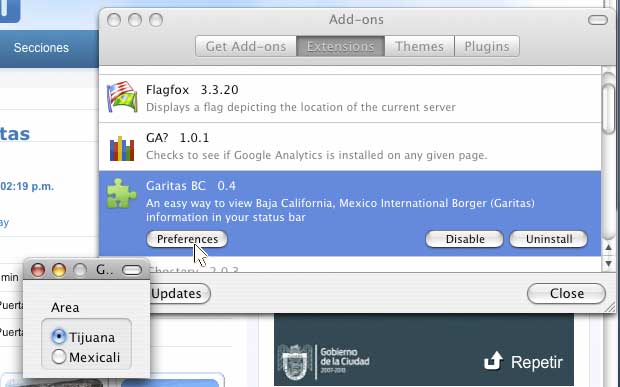
GaritasBC is an extension for Firefox that sits unobtrusively in the right-hand corner of your status bar. When you roll your cursor over it, a tooltip window pops up containing the most current reports for Tijuana and Tecate; right-click to select from a menu of Telnor webcams. The current version of the extension also allows you to access the same information for the Mexicali crossing.

ext_in_use.jpg
click to enlarge

GaritasBC currently reports all northbound wait times, in Spanish. The source of this information is U.S. Customs and Border Protection, which currently updates its data at the top of every hour. The GaritasBC extension checks for new data every ten minutes, however, so its reports are as timely as the CBP affords.

The extension can be installed automatically by downloading it while running Firefox.

Once installed, the name “GaritasBC” will appear in the status bar at the bottom-right corner of your monitor. Place your cursor over the name and the current report will appear at the tip of your cursor. Right-click (or control-click) on the name and a pop-up menu will offer the available webcams; selecting one will replace whatever is in the active window of your browser with the current static image from that webcam.

To switch between Tijuana/Tecate and Mexicali reports, chose the appropriate radio button in the extension’s preference: from the Firefox menubar -> Tools -> Add-ons -> Extensions -> GaritasBC -> Preferences.
garitas_prefs.jpg
click to enlarge

IsReal describes the development of GaritasBC as a labor of love – in other words, it is not being promoted commercially. Consequently, Firefox continues to classify it as beta software (primarily because of its austere interface and because it’s still waiting to be reviewed by the Firefox editorial team) even though it is now in its fifth version and has received no reports of bugs or instability. If the extension generates enough interest, IsReal has plans to get it out of beta by giving it more a of a graphical interface and by including reports for all the U.S. terrestrial ports of entry along the Mexican border.

Updated August 2018

The world now uses mobile apps, so this Firefox add-on has not been updated and is not compatible with current versions of the browser.

There are now about two dozen of such smartphone apps to choose from … and all of them show a lot of user dissatisfaction due to inaccurate wait times.

We need to be clear at this point: GaritasBC – as well as the smartphone apps that have replaced it – all suffer from a significant defect in that they’re little more than different “skins” for displaying Customs and Border Protection’s RSS feed.

Official CBP procedure has each Port of Entry along both land borders sending to Washington DC before the top of each hour what it estimates its wait-times are. Washington then makes the basic information available to the general public on its Border Wait Times webpage. These wait times are concerned with travelers coming into the US only. We know of no reports available for the traffic entering Tijuana.

When you check users’ reviews of the currently available apps, you’ll see a lot of anger over the inaccurate times but not over the apps themselves. As far as Tijuana goes, at least, the CBP has been wildly dishonest in its reporting of these numbers. Some of the inaccuracy is inherent in the CBP’s methodology: the data are sent to Washington only once every hour and, if that transmission arrives late, those data won’t be reported by CBP until the top of the following hour. Whenver the hamsters turning the treadmill that powers the CBP system get tired, the website continues to report the last transmission it received until the hamsters start working again.

Another reason for the inaccuracy – at least according to local lore going back several generations – is due to tortuguismo, that is, a tacit governmental policy of impeding travelers so as to make the idea of avoiding Tijuana and staying in the US more attractive. Motorists often comment that it takes them just as long to clear Customs regardless of whether there are three cars or thirty cars in front of them. Pedestrians have even stranger stories to tell.

To counter the unreliability of the official information, there have already been several attempts to harvest real-time data. One pioneering effort in this direction, bordertraffic.com, has been trying to monetize the existing CCTV traffic feeds: this might make sense for those who cross the border frequently and who are willing to learn how to interpret the video information. UCSD’s experimental app, “Border Wait Times”, attempted to crowdsource the wait times by means of its users’ GPS pings – excellent methodology – but its web server, traffic.calit2.net, was taken offline by the university without explanation. Other attempts at crowdsourced data, such as Garita Center, still need to attract a crowd. 

La Cantina de los Remedios

~ ~

photo courtesy of Cindy Mosqueda, loteriachicana.net

If you can make it to only one restaurant on your first trip to Tijuana, that one may as well be La Cantina de los Remedios. It offers a quintessential Mexican experience that can serve as the keystone to understanding all the culinary arts of Baja. The menu is Mexican comfort food, the inspiration for all our alta-cocina/Baja-Med pretensions; the setting, reminiscent of the good old days, includes sly references to the Tijuana of half a century ago.

Because the nostalgic details are historically accurate, and because the menu is strictly legit (no combination plates even though they do serve tacos, enchiladas, and tostadas), the place attracts a lot of locals out for a good time. It's also gringo-friendly – you can get both waiters and menus in English and they accept all major credit cards.

Their menu is varied enough to allow customers to share a snack over drinks, to eat a full meal, or to throw a small party. They offer more than a dozen botanas, four salads, a pasta, five soups, and three tortas. The main dishes include about a dozen forms of chicken, half a dozen shrimp and two fish fillets. Choices of grass-fed beef are extensive, including four parrilladas (mixed grills), arrachera, tampiqueña, a few filets, and a couple U.S.-style steaks. The desserts include favorites from both sides of the border such as crepas de cajeta, flan, carrot cake, and guava cheesecake. And they make one of the best margaritas in the business.

Aguilar and Castañeda come to Tijuana to say the war on drugs is a myth

~ ~
Rubén Aguilar (left) and Jorge Castañeda (right). Photo by Manuel Montoya.

by Fausto Ovalle

Rubén Aguilar and Jorge Castañeda unveiled their new book, El narco: La guerra fallida [The Failed War on Drug Trafficking], on 20 January 2010 at the Tijuana campus of the Universidad Iberoamericana (UIAT).

The president of Mexico, Felipe Calderón, used false assumptions to justify his failed drug war, say Vicente Fox’s former presidential press secretary and the former secretary of state. They point out that this war against drug trafficking was something Calderón created in order to legitimate his presidency and that it was not in his platform when he was running for office.

Cross-border pet adoption

~ ~
When Jessica and Evan moved to Tijuana, they didn’t plan on starting a charitable service. They came for the same reason that many have done lately – rents are high and incomes are low north of the border. They initially thought they’d live here while working in San Diego, but Tijuana had other plans for them.

They started in an apartment and commuted across the border. That got old fast, especially after they added a relinquished puppy to their household of cats … and then another puppy. It became obvious that there was a great need to save pets from abandonment … and that they could do this themselves … and that they’d surely be needing larger quarters.

They found a house with front and back yards close by the border and settled in to create a place “where dogs and cats of two countries unite”. To fit into their neighborhood, both Jessica and Evan started to learn Spanish. A scant year later, they’re proud to trill their RRs.

Everyone’s talking about Tijuana

~ ~

tij_panoramica_2.jpg


by Guillermo Lozano

During the last year, Tijuana showed up in the news of the furthest and most unlikely parts of the world. Never in the history of the city has it received reporters from so many countries nor ones so distant. From the end of 2008 through 2009, journalists of eleven different nations came to Tijuana in order to file special reports. Sadly, they did not come to write about our restaurants or our sports teams. They came to write about the incidents of street violence.

The efforts of the governmental tourism departments, the city’s visitors and conventions bureau, and the various PR agencies did not achieve such lavish publicity as that created by the Dantean imagery evoked in the wave of violence that followed September 2008.